
India · Regulatory Policy
Regulate the Claim, Not the Capsule
India is weighing whether a supplement’s dosage form should decide its regulator. No comparable system does that. Each of them draws the line at the claim, and each has a working middle rung that India does not.
- India
- Regulation
- Health claims
- Dosage form
- Drug regulator
- FSSAI
- Food supplements
- Probiotics
- United States
- European Union
- Australia
The question on the table
In November 2024 an inter-ministerial committee proposed moving part of the supplement category to the drug regulator: vitamins, minerals and amino acids presented in dose or dosage formats, pure probiotic cultures with an excipient base in dosage form, and disease-risk-reduction claims [4, 5]. Nothing has been enacted; it would need an amendment to the Food Safety and Standards Act.
The response split predictably. A pharmaceutical industry body warned the shift could remove a large part of the addressable market and asked for consultation [6]. A supplements association accepted that the drug regulator is better equipped to weigh clinical evidence, while warning that smaller firms cannot fund trials [7]. A consumer group pressed for the opposite: drug oversight, factory certification and price control [8].
Everyone is arguing about who should own the category. The better question is where the border runs, and there are three large systems that have already answered it.
Three reasons dosage form is the wrong border
It splits identical products. Take Bacillus coagulans at ten billion live cells. In a capsule it would become a medicine; in a stickpack of the same strain at the same count it would stay a food. Nothing about the organism, the dose or the consumer has changed. Only the packaging line has.
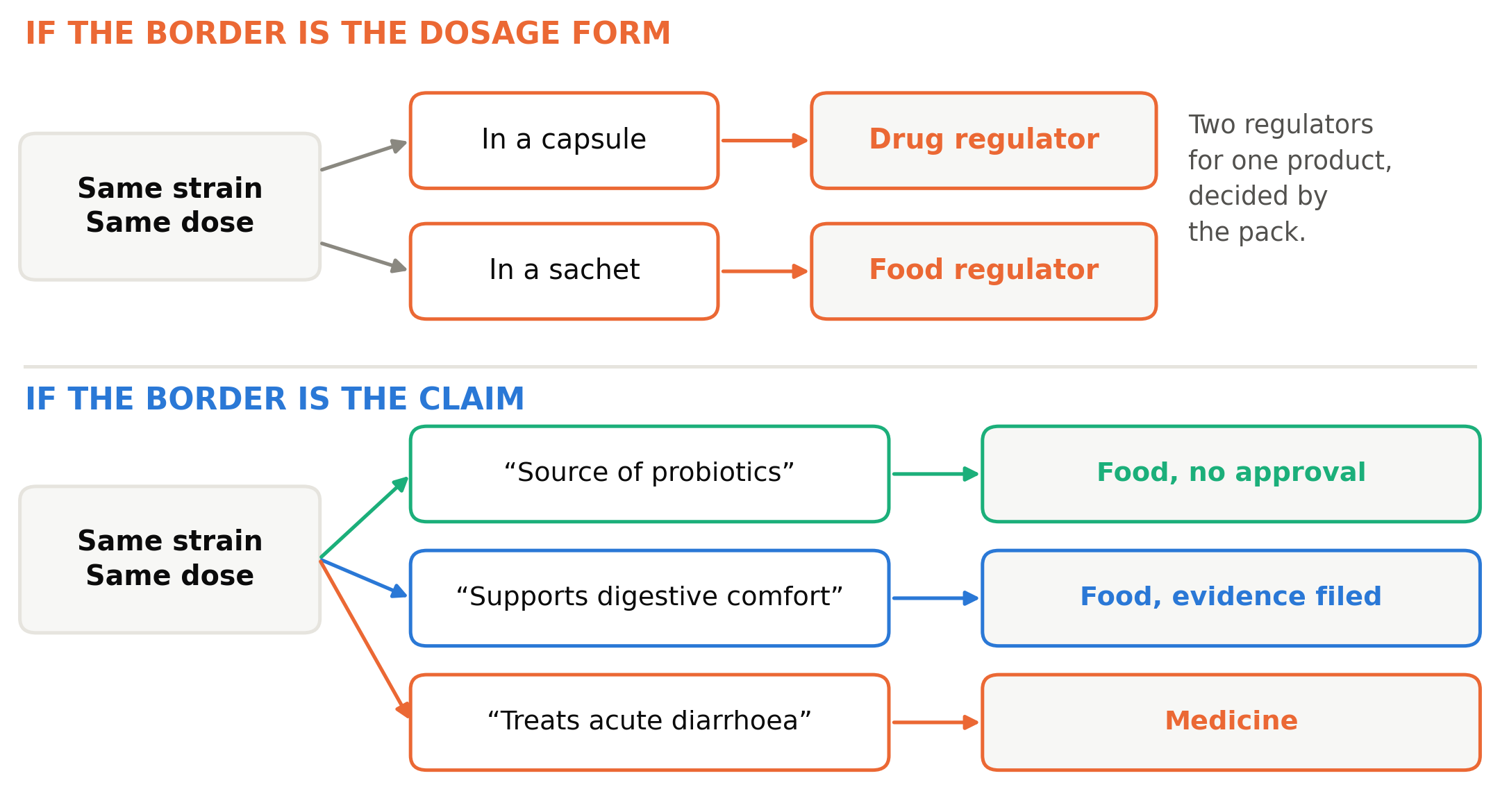
It is already unstable. Which formats a food supplement may take sits in a draft regulation kept alive by rolling directions since 2022, and under that draft, tablets, capsules, pills and drops for probiotic foods need prior approval in the first place [2]. In January 2026 a customs tribunal held that an imported probiotic culture with carriers was a biological product rather than a food supplement, because as imported it was not edible [11]. Three authorities, three logics, one organism.
It can be crossed with a filling machine. A border a formulator can step over by changing the pack is not a border; it is an invitation. The committee’s own concern was arbitrage: firms moving to the food route to escape stricter control [4]. Drawing the line at the dosage form creates fresh arbitrage running the other way.
The cost nobody has priced: one product, two factories. Schedule M, the factory code for medicines, requires manufacturing premises to be used exclusively for the production of drugs, with no other manufacturing activity on site; the 2023 revision adds that non-pharmaceutical products shall not be made in the same facilities, and places live micro-organisms alongside penicillins as needing dedicated, self-contained premises [9]. If capsules of a probiotic became medicines while sachets of the same strain stayed food, a company selling both would need two plants. Not hypothetical: in 2024, 58 units in one industrial belt holding both a drug licence and a food licence were told to give one up, and six weeks later more than seventy per cent had not complied [10].
What the big three systems actually do
This is where the proposal looks most exposed. In the United States, dosage form is part of how the law tells a supplement from a conventional food, and a supplement is expressly deemed to be a food [16]. What makes a product a drug is intended use, shown by the claim [16]. A probiotic capsule and a probiotic powder making the same disease claim are equally unapproved drugs; making the same structure-and-function claim, both are lawful supplements. When the agency acted against probiotics sold for preterm infants in 2023, the trigger was the disease intent, not the format [34].
In the European Union, “marketed in dose form” is the definition of a food supplement [21]. Capsules and tablets are named in EU law as food presentations. The Court of Justice has been explicit that external form “cannot be the sole or conclusive evidence” of medicinal status and that “the capsule form is not exclusive to medicinal products” [23]; medicinal status by function must be scientifically established, not inferred from the pack [24].
Australia comes closest to India’s instinct and still does not go there. The test is whether goods are represented, or likely to be taken to be, for therapeutic use [28]; a tablet can lawfully be a food, and the regulator says in terms that classification does not follow from a product coming in capsules or powders [29]. The one place form is decisive is sports supplements in medicinal dosage form, and that required a separate ministerial declaration in 2020 [30]. The exception exists because the general test does not work that way.
| System | What dose form does | What decides the regulator | The middle rung |
|---|---|---|---|
| United States | Separates a supplement from a conventional food. A supplement is still a food in law [16, 17] | Intended use, shown by the claim. A disease claim makes it an unapproved drug [16] | Structure and function claims, notified within 30 days, held to a substantiation standard [18, 19, 20] |
| European Union | Part of the definition of a food supplement: “marketed in dose form” [21] | Presentation or pharmacological function. Capsule form “is not exclusive to medicinal products” [23] | Authorised claim lists, Articles 13 and 14, but effectively shut for probiotics: about 400 applications, one authorised [25, 26] |
| Australia | Not part of the legal test. A tablet can lawfully be a food [28] | Representation and therapeutic purpose [28] | Permitted indications for listed medicines, an assessed pathway above them, and self-substantiated general level health claims on the food side: 1,346 notified [30, 31, 32, 33] |
| India today | A draft rule makes tablets, capsules, pills and drops for probiotic foods need prior approval [2] | Claim and presentation, under both statutes [3, 12] | Effectively empty: one probiotic claim, “source of probiotics” [3] |
| India, as proposed | Would decide the regulator for part of the category [4, 5] | Dose form, for those products | Not addressed |
The warning inside the comparison
A claim-based border is not automatically a good one. Europe has exactly the border we are arguing for, and it has produced something close to India’s silence: of roughly 400 probiotic health claim applications, one has been authorised (live yoghurt cultures and lactose digestion) [26]. The word “probiotic” is itself treated as a health claim, a position the European Ombudsman declined to disturb in December 2024 [27].
Australia is the working model. It pairs a closed, published vocabulary of permitted indications for listed medicines (including “maintain/support intestinal good/beneficial/friendly flora” and “help restore good/beneficial/friendly gut flora after antibiotic use” [31]) with an assessed pathway for sponsors who want to say more [32], and, on the food side, general level health claims that a company may self-substantiate by systematic review and notify before use [32, 33]. That last route carries real traffic: 1,346 notified food-health relationships, several of them probiotic [33].
The lesson is not that claims are the wrong border. It is that a claim border with a closed middle rung produces silence, and silence is what India has now.
A three-rung evidence ladder
India already sorts by claim: content claims, the eight permitted disease-risk-reduction claims, and disease claims that are prohibited outright [3], and drug law does the same from the other side [12]. The border exists. What is missing is the middle. Exactly one probiotic claim is listed, “source of probiotics”, pitched at the same 100 million live cells that composition already requires [1, 3], so it grants nothing beyond the category word on the pack.
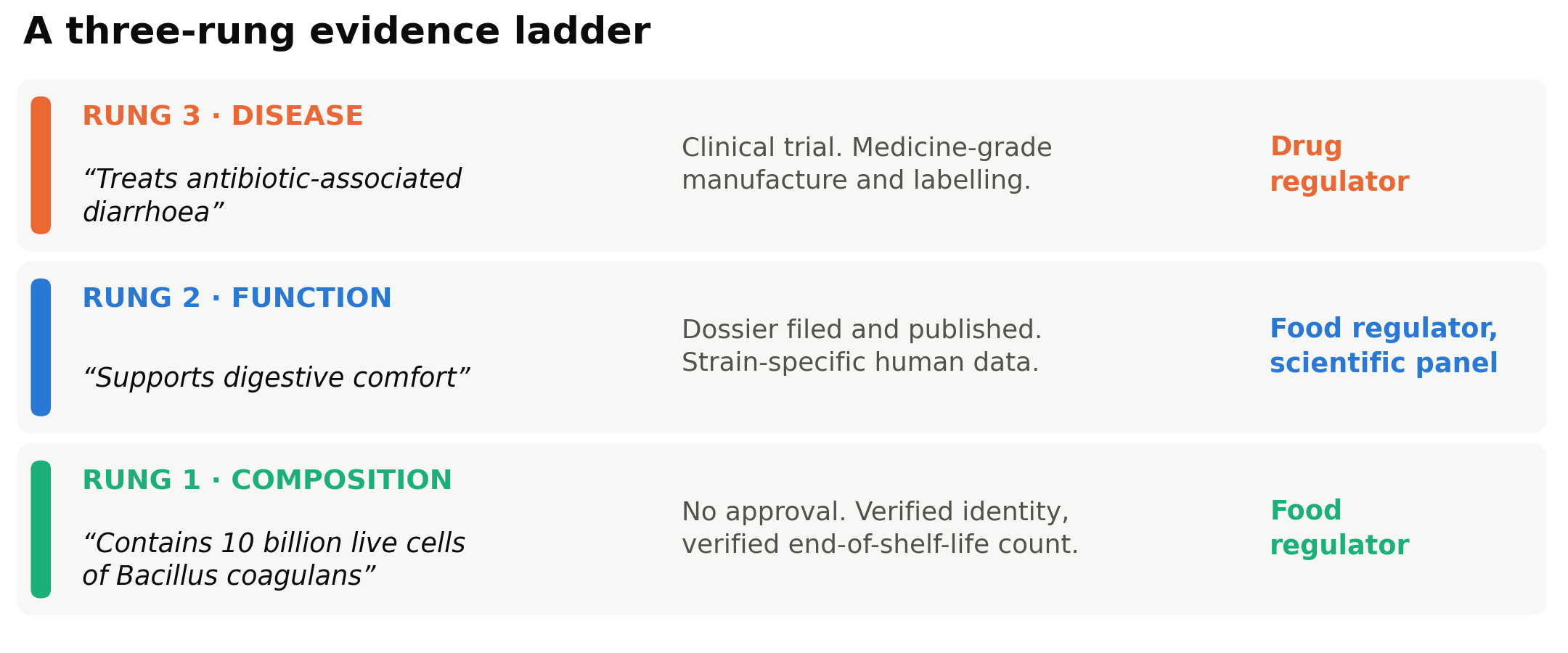
Rung one, composition. No approval, but real verification: species and strain confirmed by sequencing, and the declared count verified at the end of shelf life, which is already what the label rule demands [1].
Rung two, function. A dossier filed and published, with strain-specific human evidence assessed against a published standard, as in the Australian design, where the sponsor does the systematic review, notifies before use, and carries the liability [32, 33]. The claim travels with the strain, not the species, and the entry is reviewed on a fixed cycle.
Rung three, disease. The drug route, as today. The drug regulator already polices this line from its side: in April 2025 it directed States to stop thirty-five combinations licensed without central evaluation, several built on supplement ingredients [15].
Under this design the dosage form becomes what it should be: a formulation decision about stability, palatability and cost.
Three objections, taken seriously
“Small firms cannot fund clinical trials.” Rung two is a dossier, not a trial mandate. Australia’s food-side route asks for a systematic review of existing evidence, not a new study [32], and the United States asks for substantiation held by the company rather than submitted in advance [19, 20]. The bar is that the evidence belongs to the strain in the pack.
“The drug regulator judges clinical evidence better.” Very likely true, which argues for a joint scientific panel on rung two, or for an assessed pathway of the Australian kind, not for a wholesale transfer of capsules.
“Only the drug route brings price control.” Price control is an affordability instrument, not a safety one. India pulled the affordability lever in September 2025, cutting the tax on supplements from eighteen per cent to five, without touching jurisdiction [14].
Three steps, none of which need a new law
- Publish the rung-two evidence standard. What study designs, endpoints and strain-matching count. Without it, “prior approval” is a door with no handle, and Europe shows what a door with no handle does to a category [26].
- Notify a method for counting live organisms. India’s microbiology manual covers pathogens and spoilage organisms and sets no method for enumerating probiotics [13], so even a composition claim cannot be verified.
- Open one classification desk with published rulings. A borderline product should get one answer in weeks, not three different answers from three authorities [2, 11, 12].
Every system worth comparing India to has settled on the same instinct: what a product says about itself is what decides how hard the state looks at it. The shape of the pack has never harmed anyone. Regulate the sentence.
Working on this? If you are building a probiotic range in India and weighing capsules against sachets, or working out what evidence a function claim would need, we are glad to compare notes. Write to us at info@aesclebio.com.
A question for our readers: if a function-claim route with a published evidence standard opened tomorrow, would your company file a dossier, or keep saying nothing?
Notes and sources
Every citation number in the text links to this list; each entry links to the source. Dates are as at 25 September 2026. Where a proposal has not been enacted, that is stated in the text.
- Food Safety and Standards (Health Supplements, Nutraceuticals, Food for Special Dietary Use, Food for Special Medical Purpose, Functional Food and Novel Food) Regulations 2016, regulator’s compendium, 29 September 2021. Regulation 10 on food with added probiotic ingredients, the minimum of 100 million live cells per recommended daily serving and the end-of-shelf-life declaration. Link
- Direction of 30 March 2022 operationalising the draft 2022 regulations, with the annexure listing permitted delivery formats and providing that tablets, capsules, pills and liquid drops for prebiotic and probiotic foods are permitted only with prior approval. Applied by rolling directions since; confirm the current one before relying on it. Link
- Food Safety and Standards (Advertising and Claims) Regulations 2018, compendium version IV, 14 December 2022. Schedule I (“source of probiotics”), Schedule III (eight permitted reduction-of-disease-risk claims), regulation 10 (prohibited disease claims) and regulation 11 (prior approval). Link
- “Inter-ministerial committee calls for amendment in FSSAI Act on nutraceuticals”, PharmaBiz, 13 November 2024. Link
- “Top panel suggests bringing health supplements under drug laws, greater scrutiny of their claims”, ThePrint, 15 November 2024. Eight-member committee, constituted January 2024; recommends that pure probiotic culture with an excipient base in dosage form be regulated by the drug regulator. Link
- “Pharma groups criticise plan to shift nutraceuticals under drug authority”, Business Standard, 17 July 2024. Link
- “India’s inter-ministerial committee’s nutraceutical regulatory proposal draws mixed responses”, NutraIngredients, 26 November 2024. Link
- “Gujarat-based NGO seeks CDSCO oversight for nutraceuticals, flags concerns”, Business Standard, 19 April 2026. Link
- Revised Schedule M to the Drugs and Cosmetics Rules 1945, notified by G.S.R. 922(E) of 28 December 2023. Opening note (premises to be used exclusively for the production of drugs) and clause 12.6.1 (dedicated, self-contained facilities for biological preparations with live micro-organisms; non-pharmaceutical products not to be made in the same facilities). Hosted copy of the notified text. Link
- “Pharmaceutical units having dual licences face the heat”, The Tribune, 15 March 2024, and “No relief provided, pharma units start surrendering licence”, The Tribune, 26 April 2024. 58 units directed to surrender one of two licences; over 70 per cent had not complied six weeks later. Link
- Sundyota Numandis Probioceuticals Pvt Ltd v Principal Commissioner of Customs, Customs Excise and Service Tax Appellate Tribunal, New Delhi, 29 January 2026. Probiotic culture with excipient carriers classified under heading 3002, not the food-preparation heading; classification judged by the condition of the goods at import. Link
- Drugs and Cosmetics Act 1940, section 3(b). Definition of “drug”, including substances intended for the treatment, mitigation or prevention of disease, and the “other than food” carve-out in the structure-or-function limb. Link
- Manual of Methods of Analysis: Microbiological Examination of Food and Water, Food Safety and Standards Authority of India. Methods FSSAI 15.001:2023 to 15.040:2023 cover pathogens, indicator organisms and spoilage organisms; no reference method for enumerating probiotic organisms. Link
- Notification 9/2025-Central Tax (Rate), 17 September 2025, effective 22 September 2025. Schedule I, serial 145, places heading 2106 food preparations at 5 per cent, the rate applying to food supplements. Mirror of the notification text; the official portal was unreachable at the time of writing. Link
- “Govt bans 35 combination drugs, see full list”, Medical Dialogues, 16 April 2025. Central directive on combinations licensed without central evaluation; the list includes supplement-type ingredients such as coenzyme Q10, vitamin D3, omega-3 and lactic acid bacillus. Link
- Federal Food, Drug and Cosmetic Act, section 201(ff) and section 201(g) (21 U.S.C. 321). Definition of a dietary supplement, the deeming provision that a supplement is a food, and the definition of a drug by intended use. Link
- 21 U.S.C. 350(c)(1)(B). The dosage-form list (tablet, capsule, powder, softgel, gelcap or liquid form) cross-referred by the dietary supplement definition, with the alternative limb for products not in those forms. Link
- Federal Food, Drug and Cosmetic Act, section 403(r)(6) (21 U.S.C. 343). Structure and function statements, the substantiation requirement, the mandatory disclaimer and notification to the agency within 30 days of first marketing. Link
- 21 CFR 101.93. Notification procedure and the criteria distinguishing permissible structure and function claims from impermissible disease claims, including implied claims through product name, formulation and imagery. Link
- Federal Trade Commission, Health Products Compliance Guidance, 20 December 2022. The “competent and reliable scientific evidence” standard applied to health-benefit advertising. Link
- Directive 2002/46/EC on food supplements, Article 2(a). Food supplements are foodstuffs “marketed in dose form, namely forms such as capsules, pastilles, tablets, pills … sachets of powder, ampoules of liquids, drop dispensing bottles”. Link
- Directive 2001/83/EC, Article 1(2) (medicinal product by presentation and by function) and Article 2(2) (medicines law prevails in cases of doubt). Link
- Case C-319/05 Commission v Germany, Court of Justice, 15 November 2007. External form “cannot be the sole or conclusive evidence” of medicinal status, and “the capsule form is not exclusive to medicinal products”. Link
- Case C-140/07 Hecht-Pharma, Court of Justice, 15 January 2009. Medicinal status by function must be scientifically established; doubt about the science is not “doubt” within Article 2(2). See also Case C-27/08 BIOS Naturprodukte, 30 April 2009, on case-by-case assessment of all the characteristics of the product. Link
- Regulation (EC) 1924/2006 on nutrition and health claims, Articles 10, 13 and 14, and Commission Regulation (EU) 432/2012 establishing the Union list of permitted general function claims. Link
- International Probiotics Association Europe, European legal framework. “almost 400 health claim applications with probiotics have been submitted for authorization. Only one was authorized.” The authorised entry is the live yoghurt cultures and lactose digestion claim in the Union list. Link
- European Ombudsman, decision in case 2273/2023/MIK, 20 December 2024. No maladministration in the Commission’s treatment of the word “probiotic” as a health claim. Link
- Therapeutic Goods Act 1989 (Australia), section 3(1). Definitions of “therapeutic goods” (goods represented in any way to be, or likely to be taken to be, for therapeutic use) and “therapeutic use”; the food carve-outs; and section 7 declarations. Link
- Therapeutic Goods Administration, “Know how food and medicine are regulated” and the Food-Medicine Interface Guidance Tool. Classification does not follow from the fact that a product comes in capsules or powders, nor automatically from the making of health claims. Link
- Therapeutic Goods (Declared Goods) Amendment (Sports Supplements) Order 2020, made 23 September 2020. A separate declaration was needed to make medicinal dosage form decisive for sports supplements, transition ending 30 November 2023. Link
- Therapeutic Goods (Permissible Indications) Determination (No. 1) 2025, registered 2 April 2025. The closed vocabulary of indications available to listed medicines, including “maintain/support intestinal good/beneficial/friendly flora” and “help restore good/beneficial/friendly gut flora after antibiotic use”. Link
- Therapeutic Goods Administration, assessed listed medicines pathway, available since 19 March 2018. Pre-market assessment of efficacy evidence for indications above the permitted list, with a label statement that efficacy has been assessed. Link
- Australia New Zealand Food Standards Code, Standard 1.2.7 (nutrition, health and related claims) and Schedule 6 (required elements of a systematic review). General level health claims may be self-substantiated by systematic review and notified before use. Link
- Food Standards Australia New Zealand, register of notified food-health relationships. 1,346 notified relationships as at 25 September 2026, including probiotic entries such as “supports digestive comfort”. The agency states it does not assess the merits of notified relationships. Link
- Food and Drug Administration, “FDA raises concerns about probiotic products sold for use in hospitalized preterm infants”, 26 October 2023. Warning letters treating probiotics with disease-prevention intent as unapproved drugs and biologics, whatever their format. Link
This article is commentary on published regulatory proposals. It is not legal advice and makes no health or efficacy claim about any product. The evidence ladder described here is our proposal, not a regulatory position. Two source notes: the revised Schedule M and the September 2025 tax notification are cited from hosted copies because the official portals were unreachable at the time of writing; the Indian microbiology manual carries a 2023 method series.